
Moran Insurance Group
Licensed Insurance Brokers
Call us today
863-270-9820
Employee benefits strategy for companies with 51 to 1,000+ employees: funding options, a renewal you can actually evaluate, and compliance on a calendar, from an independent team licensed in 31+ states.
In New York, groups of up to 100 employees stay in the small group market. We confirm the rules for your state first.
Projected 2027 rise in employer cost per employee after planned changes, the largest since 2003 (preliminary).
What employers said their cost would rise if they changed nothing.
Other 2027 projections before cost-cutting changes, from Aon, Business Group on Health, IFEBP and WTW.
Share of covered workers at large firms in self-funded plans, versus 27% at firms with 10 to 199 workers.
A first renewal number is a starting point. Groups your size usually have options smaller groups don’t: claims experience, competing funding models and time, if you start early. Projections are national figures, not a forecast for your plan.
Sources: Mercer: health benefit costs expected to jump in 2027 (preliminary); PlanSponsor: 2027 employer cost projections; KFF 2025 Employer Health Benefits Survey.
Fully insured, level funded, self-funded and ICHRA modeled on your census and, where available, your claims.
We take your plan to the leading available carriers and funding partners, then walk you through the responses we receive, including the declines.
Usually the fastest-growing cost line: GLP-1 coverage choices, formulary changes and, on self-funded plans, pharmacy contract terms.
Form 5500, ACA reporting, gag clause attestations and required notices, coordinated with carriers and specialist partners.
Enrollment support, a benefits guide your people can actually read, virtual open enrollment meetings and help when a claim goes wrong.
Claims and cost reviews on level-funded and self-funded plans, as the carrier or administrator provides the data.
Large group rating in most states, the ACA employer mandate and reporting, claims data and leaving a PEO.
Read the 51 to 99 guide →Form 5500, when self-funding becomes realistic, pharmacy costs and a realistic timeline.
Read the 100 to 249 guide →Self-funding as the norm, stop-loss and pharmacy contract terms, claims data and a benefits committee process.
Read the 250+ guide →| Option | What it is | Usually fits when |
|---|---|---|
| Fully insured large group | A fixed premium; the carrier carries the claims risk. | You want predictable cost and minimal administration. |
| Level funded | A fixed monthly amount covering expected claims, stop-loss and administration, with a possible refund of unused claims money depending on the plan’s terms. | The group is reasonably healthy and wants refund potential with a capped downside. Not generally available to New York groups of 100 or fewer. |
| Self-funded with stop-loss | The employer pays claims as they happen, with specific and aggregate stop-loss limiting large losses, set up with our administration and stop-loss partners. | You have the size, cash flow and appetite for claims risk in exchange for control and data. |
| ICHRA, or ICHRA plus group by class | A defined monthly allowance employees use for individual plans; CMS now calls it a CHOICE Arrangement. Can sit beside a group plan for different employee classes. | Hourly, seasonal or multi-state workforces, or a fixed budget per class. |
| Captive or reference-based pricing | Specialist structures brought in through partners. | The numbers and the group’s risk profile support them; we tell you when they don’t. |
Sources: CMS: CHOICE Arrangements, previously known as ICHRAs; New York DFS: small group expansion to 1-100 employees.
An example for a group renewing on January 1. We adapt the dates to your plan year, your carrier and whether you are changing funding.
Late? We still review a renewal 30 days out. There is just less room to negotiate.
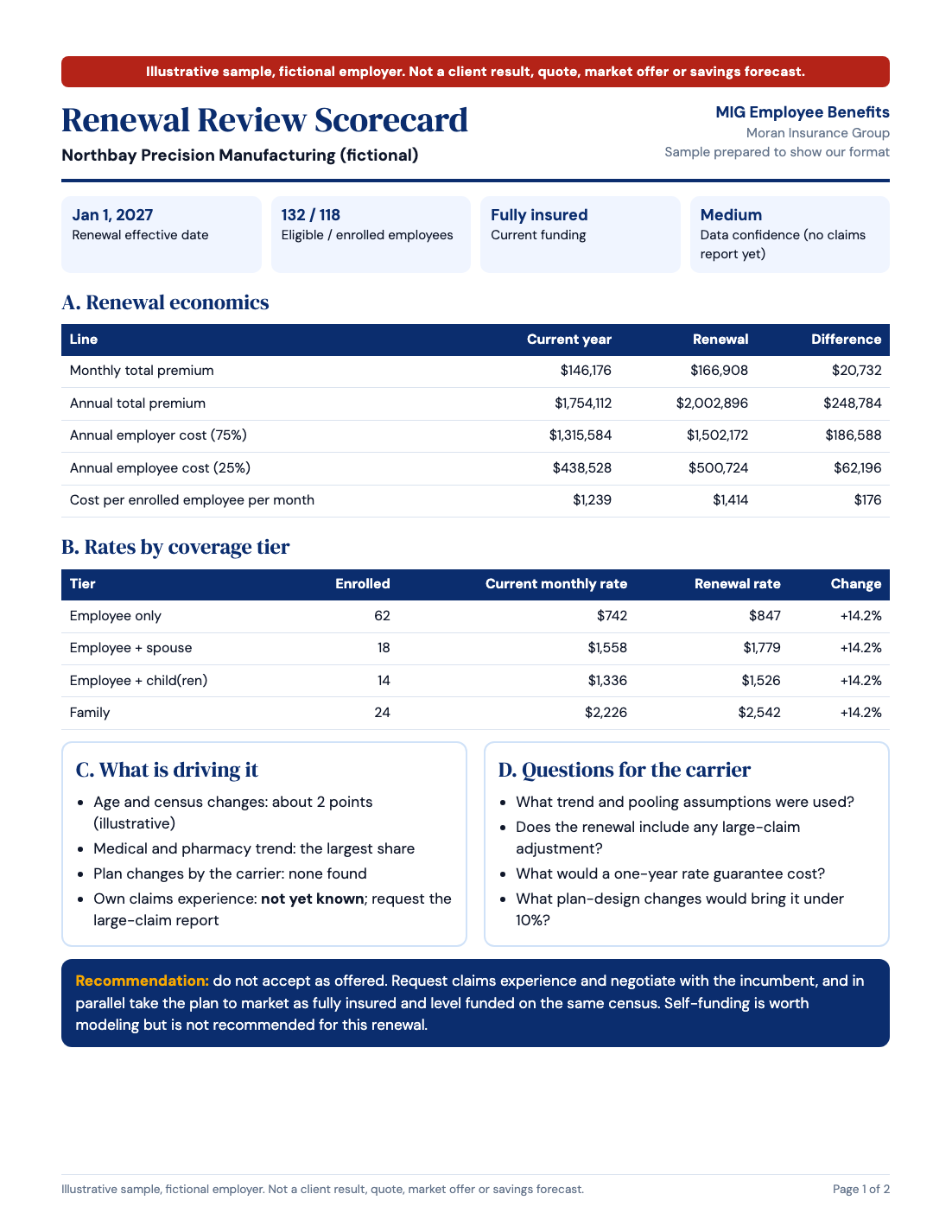
Every larger-group engagement produces written work you can share with your leadership team:
Carriers or plan providers pay our commission, and we do not add a separate broker fee. Before any contract or renewal, you get a written description of our services and all the compensation we expect to receive, as federal rules require for ERISA group health plans of any size. How we’re paid explains it in detail.
A broker change can often be handled with a broker of record letter, without changing your plan or your employees’ ID cards. Carrier rules, timing and what information moves with the change vary, so we confirm them with your carrier before you send anything, and we never contact your current carrier or broker without your OK.
Comparing advisers first? Our benefits broker RFP guide lists the questions to ask any broker, including us.
Form 5500: insured plans with 100 or more participants at the start of the plan year; a plan that holds money in a trust or separate fund can owe it below 100.
ACA reporting: Forms 1094-C and 1095-C for Applicable Large Employers.
RxDC: the annual prescription drug and spending report, due each June 1 for the prior year.
Gag clause attestation: due every December 31, for plans of any size.
Plan documents: summaries of benefits and coverage, the plan document and the summary plan description.
COBRA: generally for employers with 20 or more employees in the prior year, plus state continuation rules.
Section 125: the plan document that lets employees pay premiums pre-tax.
Medicare Part D: creditable coverage notices before October 15, and the CMS disclosure within 60 days of the plan year start.
We are brokers, not attorneys. Filings and plan documents come through your carrier, your administrator or our compliance partners; our team keeps the dates and makes sure the right party has each one.
Sources: U.S. Department of Labor: Form 5500 series; IRS: determining if an employer is an Applicable Large Employer; CMS: prescription drug data collection (RxDC); CMS: gag clause prohibition compliance attestation; U.S. Department of Labor: COBRA.
Your account is handled by our licensed team, with a clear point of contact and direct access to the people doing the work. Behind us sits a partner network for the pieces a larger plan needs: third-party administrators and stop-loss carriers for self-funded and level-funded plans, ICHRA administration platforms, benefits administration and enrollment technology, and compliance specialists for plan documents and filings.
See how we work, our team and credentials and how we handle your data.
Carriers look at your group’s demographics, plan design, medical and pharmacy trend, and, at larger sizes, your own claims experience. The renewal letter shows the result, not always the reasoning, which is why we ask for the rate exhibit and any claims report before we judge it.
For 51 to 249 employees, 150 to 180 days before the effective date gives time to gather data, take the plan to market and change funding if it makes sense. Renewals often arrive 60 to 90 days out; if yours already has, we still review it, there is just less room to negotiate.
It helps but is not required to start. Many carriers provide claims experience or large-claim reports to groups of this size on request, and level-funded and self-funded plans usually report claims regularly. We tell you what to ask for.
Usually, yes. The timing depends on your PEO agreement’s notice terms and your new plan’s effective date, and deductibles generally restart on a new plan, so the switch date matters. See leaving a PEO.
Yes, with specialist partners for third-party administration and stop-loss. We model whether self-funding fits your size, cash flow and risk tolerance before recommending it.
Carriers or plan providers pay our commission, and we do not add a separate broker fee. Before any contract or renewal, you get our services and compensation in writing, as federal rules require for ERISA group health plans. See how we’re paid.
Usually not. A group plan is based in the employer’s home state, and national networks or multi-state carriers can cover employees elsewhere. We check network fit where your people actually live.
Yes. We quote those lines alongside medical, so one proposal covers the whole benefits package.
Upload your renewal and plan details. Within 5 business days of receiving them, you get a written review: what changed, whether it is worth taking to market, and the funding options worth a look.
The review is advisory. It is not a carrier quote, an actuarial opinion or a guarantee of savings.